


As much as I wanted to go bigger, to make things with seriousness and weight, I kept coming back to tiny things. At a certain point I just let myself go smaller and smaller. No more delusions about changing the world, disrupting the rolling status quo. Just small suggestions of wonder. So, this past year I have unintentionally, through the byproduct of trying to make a lot of personal work, been studying a lot about colour.
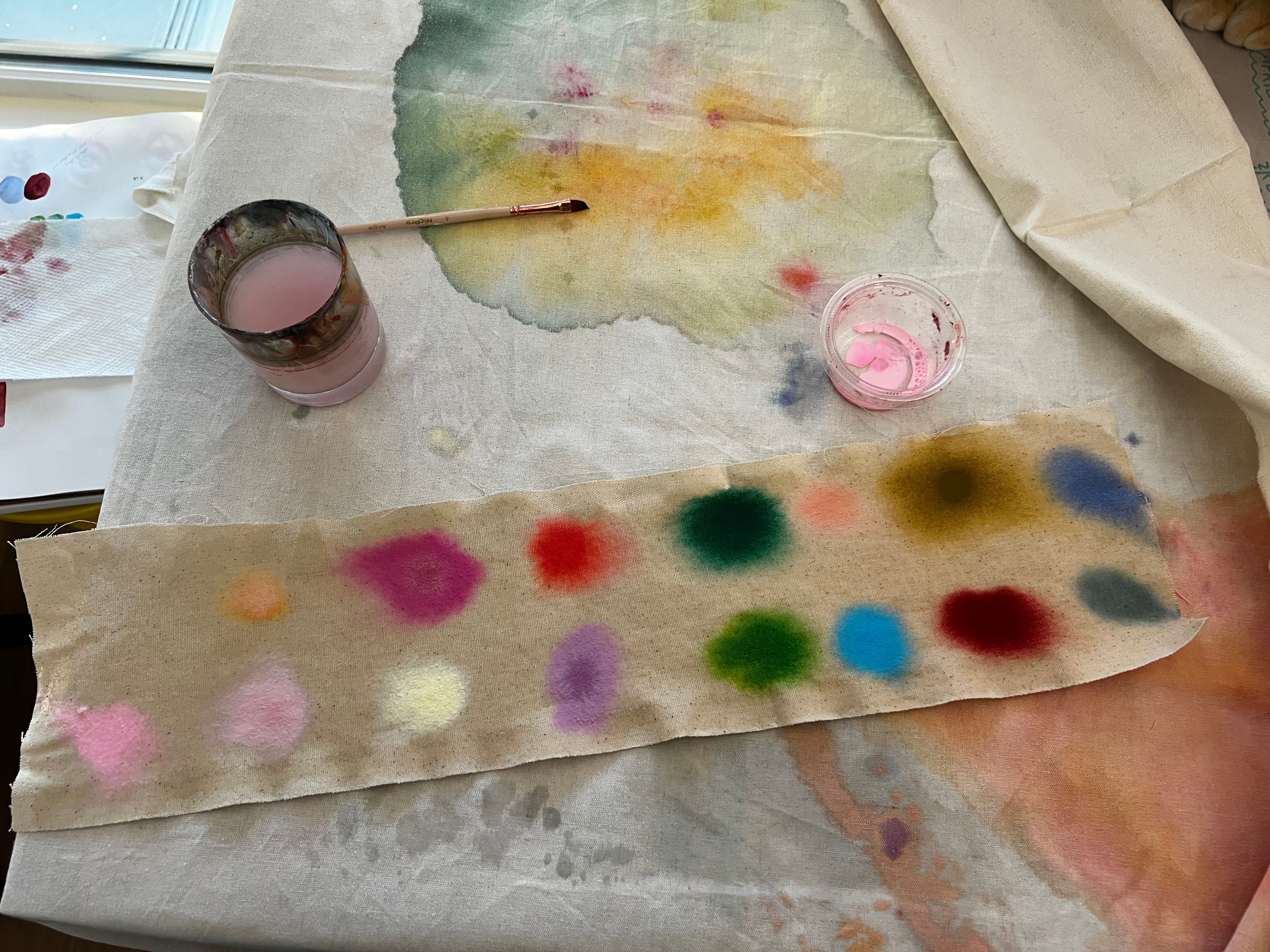
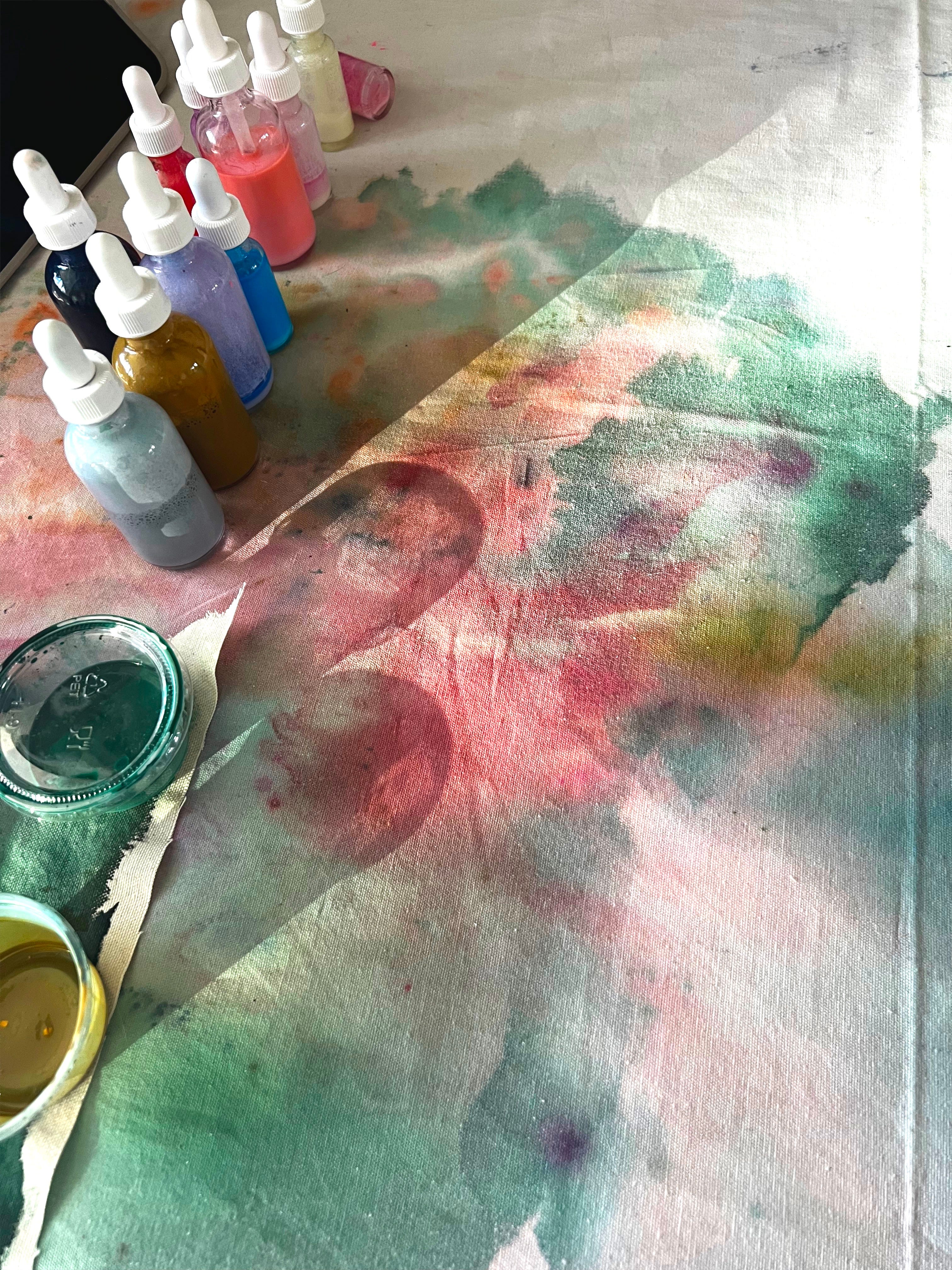
For more than a decade before, I had been doing that but digitally and with words, using software and poetry. But in the fall of 2024, after my living situation had stabilized, I decided (surrendered?) to trying something different, to satisfy the persisting itch of working with colour outside of what I had become comfortable with. First a poem printed, then pencil crayon, then paint, pigment, pastel, water, ink, back to the computer but with motion and code, then back to paint. I wasn’t used to it. I hadn’t touched paint or fabric in more than a decade, for a reason. Everything was much easier and faster using a colour selector tool on the computer, of course, or simply calling out a colour using words to try to contain a meaning. I loved not having to get messy.
Just because you’ve got the end result right doesn’t mean you’re getting it. I’m reminded of math class and the whole showing the work thing. And it took me this long to really get that the work is the work, if that makes sense. Working with colour in all these old and new ways was fun but also a lot more laborious. I had to actually learn technique, then practice. Theory is never enough. I had to spend time, effort, material. I had to study masters of light and colour to understand. I had to make mistakes. I had to look at the real world, like my mom had always told me. “Look at something green once in a while”, she’d say. (So tempted now to answer, whenever she asks me what I’m working on: “looking at something green, just like you told me to.”)
Coming out of tech and the startup world, there’s a lot I had to shake off. How to stick with things that aren’t immediately clicking, how to not see everything as a binary A/B test, how to resist the acquired and desired instinct to “move fast and break things”. Also, how to not automatically think that every little problem has to end in an app, solution, hack, or startup.
But there is one thing that’s stuck: the minimum viable product. The smallest unit of an idea. And for me, I’ve gone back and gone deep to find that I have been circling around the idea of working directly with colour for a very long time. It’s certainly not the best idea, but it’s persistent and powerful. I can go long and go deep with it.
Colour is so small and yet so big. It’s so much distilled and so much contained. The thing is, when I opened myself up to working with colour and seeing it in all different kinds of ways—through science, poetry, material, psychology, history—I was able to create and communicate things I couldn’t quite before, like I was orbiting but afraid to land in the mud of the work. It gave me more to work with: some things you can see (ie. the subtleties of light in real life: shimmer, translucency, gloss, movement), and some things you can’t.
A year ago I was thinking a lot about the proliferation of artificial intelligence, how I was going to orient myself in the new landscape of creative work. I was afraid to be left behind, a constant humming fear of mine that gets more pronounced the older I get and the less tethered I get from traditional milestones. The work has taught me where I want to be, how to tell the difference between output and work/art/progress. One is now simple to achieve, the other can be simple to look at. They are not the same thing.
Some updates:
I’ve merged my two Substack publications so if you haven’t heard from me in a few years (sorry), that’s why.
I changed the name of this Substack to “A Horse Inside”, which comes from this cute quote that I first came across in a book and that Poetry Foundation tells me is from a paper handout made by poet and professor Henri Cole:
“A poem is an egg with a horse inside.” —A third grader
Paid subscriptions are paused and have been for a long time. I do plan on activating them again soon, once I figure out what to offer as a paid subscription perk. In the meantime, there are no paywalls and all archives are available to read.
(!!) I’m launching something new over on my website on November 24, just in time for the holidays. My first “real” thing in a while!
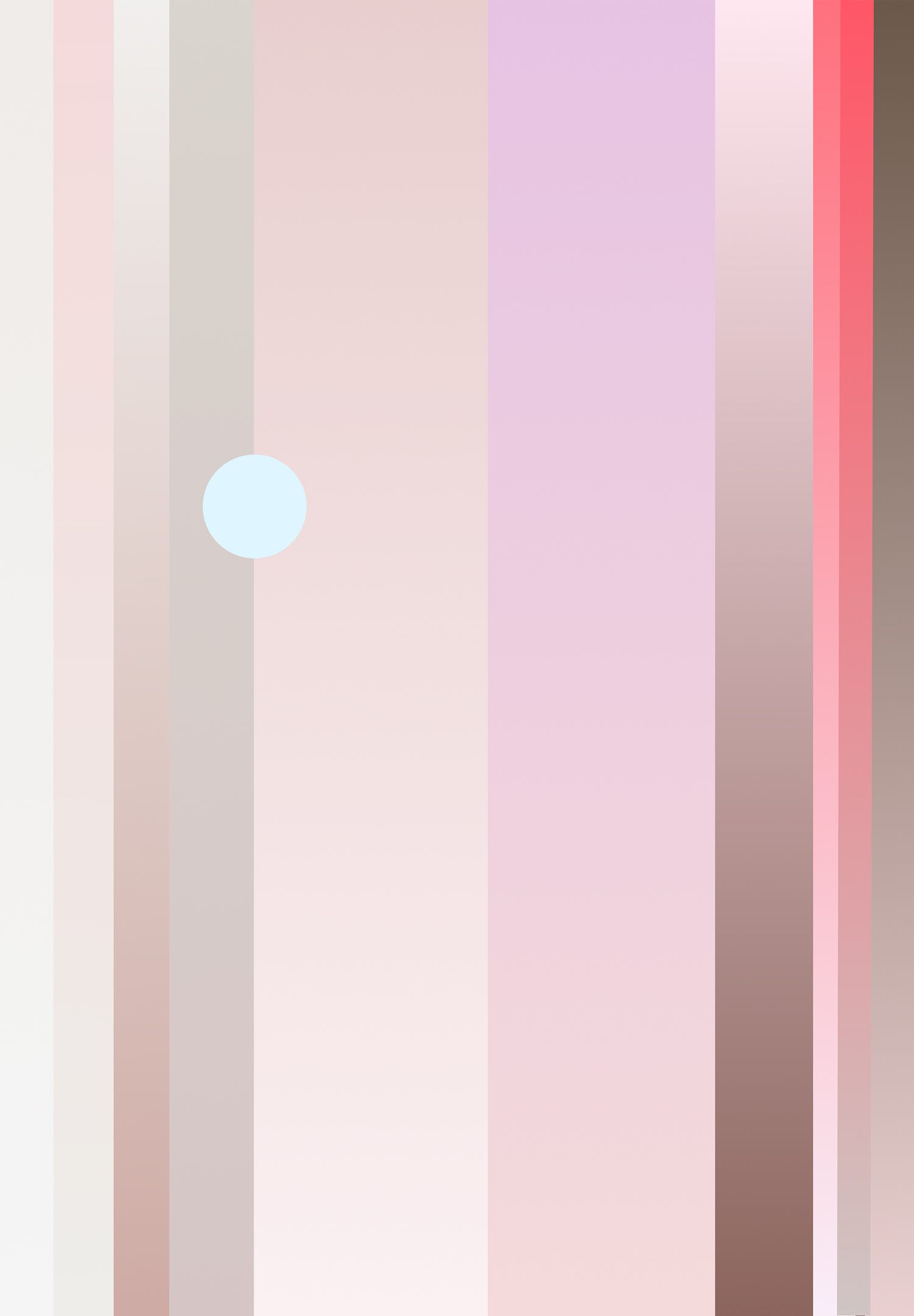
They can’t make a neon that outlasts UV. Just like you can’t scale down to grey and make all the colours big. But you keep trying, each attempt use a different chord until the entire song comes out in pieces. A mess of notes and their unseen harmony. And there, green is the widest colour.
“Just because you’ve got the end result right doesn’t mean you’re getting it. I’m reminded of math class and the whole showing the work thing.”
That distinction matters. A correct outcome can hide a flawed process, and over time the process is usually what determines whether the result holds.
Hello Ana! Idk who you are but somehow substack brought your page to me and I just wanna say something about you line of thinking feels so fizzy. I find myself thoroughly enjoying it (perused your other posts too, plus the gold egg icon just… gets me). I also don’t know what to offer in return for letting us into your thinkpiece here, but on your mentioning of the tech world and how it intersects creativity, I thought I’d just share something—recently I attended a lecture by sf/f writer Ken Liu and he opined something that struck me enough to write it down: “Technology is a form of epic poetry. Engineers are expressing their values in the things they build”. There is so much poetry in everything and you seem adept at such a variety of ways of buildings. So at the risk of sounding glib, I hope you find joy with all the material things you’re building with beyond words