

Purpling
Are you nothing yet?

In my early 20s I held a brief stint as a professional photographer. I wasn’t very good compared to the many photographers whose work I admire now; I just happened to be working for a photographer and when I’d been there long enough, he decided I should learn. I bought a camera and caught the bug. Career highlights: a photo in Vogue online, in the local newspaper (thrice), and that was pretty much it. All I’m left with now is a pre-mirrorless camera on its very last legs (is it vintage yet?) and some knowledge of how cameras work.
Aperture is the function of a camera that determines how much light is let in. The smaller the aperture, the bigger the hole, and the more light is let in. At the same time, the separation between subject and periphery becomes more distinct as the depth of field increases. This one setting, therefore, affects two aspects of a photograph.
I am writing to you today having just finished ten days of shuttling my niece around, including to and from her many extracurriculars. I was often the first one parked to pick her up from school (fear of being late and reprimanded as “bad auntie” by teachers and parents), and in between that and waiting in the sidelines while she swam, skated, or jiujitsu-ed, there was some downtime. (Many parents, I discovered, spend this time glued to their phones. One parent had his laptop out appearing to be working, whilst he was actually playing a game. As a non-parent, I by nature have plenty enough time to doom-scroll, so I decidedly did not want to do that.)
Luckily I had a brief prepared: write the poem for my newest two Colourdrops.
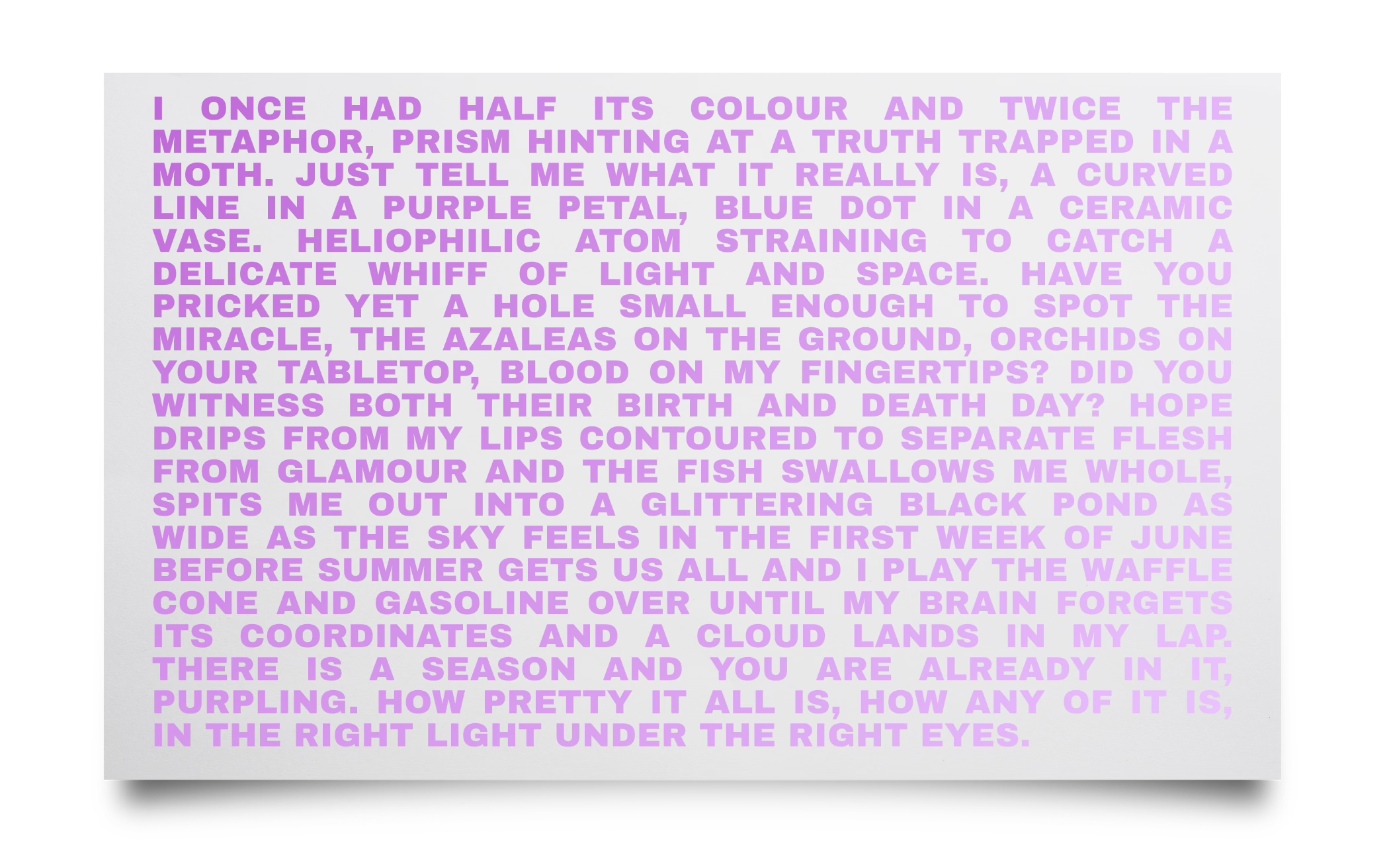
Orchid Milk and Orchid Jelly mark #7 and #8 in this ongoing practice (both are available for pre-orders), and as always, there is a poem paired with each colour. Two ways of extracting feeling from the same source: one material (colour as object) and the other, metaphorical (colour as poem).
Being a very occasional caretaker to young children is in a way its own kind of aperture setting. I mentioned how it felt like I forgot my entire life otherwise, like my depth of field adjusted. My brother texted and said something similar, how work doesn’t matter anymore after having kids. I can understand that. I think a lot of us are tricked into caring about work. There’s a kind of built-in system of communal validation and reward that’s so easy to buy into, and so hard to get out of. Until something like children, a pandemic, or tragedy comes along.
Notebook out, windows down in the heat of my car, seat all the way back. Here we go. I started with a line I’ve used before in a different poem, a line that has stuck to me. The next day at a skating rink, the poem was done.
We look at light as something that happens, sun streaming through the windows, mornings rising and daylight ending, but just look at all the ways we have invented to control light, to control what we can see. Technology, yes: lamps, lighting, cameras, and now in more metaphorical terms, algorithms and feeds and all the engineering that goes into keeping you looking.
I struggle all the time with my work feeling insubstantial. I have data pointing towards the fact, my algorithm telling me to look elsewhere. But I’m trying to develop more self-assurance based on the principles from The Timeless Way of Building, the 1979 book by architect Christopher Alexander that has become my creative bible: that to build the world you desire you have to start from an indescribable feeling that can best be encapsulated into a word from the English language as “aliveness”.
When I am working on a colour, I am changing my aperture to focus entirely on the lowest resolution of a thing, an extraction of something in my world that feels alive. But part of what pulls at me is this singular precision that somehow translates into further and further dimensions. I am tuning in completely into a specific register of light that means so many other things, depending on how you want to look at it.
I think I’ve close to cracking why I obsess over colour like this. It’s the most distilled version of a nameless question, kind of like when a kid keeps asking why, and you realize there is always another answer, and they realize they haven’t gotten to the bottom yet. I’ve been working with colour for a long time. It took me a long time to figure out that whenever I worked with colour through a screen it did not feel whole even though it was the most precise way I could do it. Then it came to me: you don’t forget when you know something is right. I used to work with fabric. A screen doesn’t compare to fabric. Because I had worked with fabric for many years, in a way hardly anyone does, I had a sense that something was missing. I am, probably like most people without knowing, looking for that feeling of wholeness.
Sometime during the week, my niece asked me what my favourite colour is. I told her every colour is my favourite when I look at it a certain way. Her question pulled out so quickly what I think is the crux of this practice. (Great example: I am currently working on my next colour and it shares the same hue as the highly memed backdrop of a breakout horror movie right now.)
When I was a copywriter I dealt with this all the time. Take this line:
Looks like nothing. Feels like everything.
A copywriter’s way of describing what Colourdrops are. Like with most things, it means more when you see what I am working in opposition to, its contrast:
Looks like everything. Feels like nothing.
But notice this: The line above could be interpreted as positive (“nothing” as lightness and freedom, which I have often used when I wrote for athletic wear), or negative (“nothing” as flat, numbed, which I often use because that’s the perennial state of being in 2026). Nothing is not everything but it is many things.
All I am doing is letting the light in. And when it is done, it’s simple but, and this is important, it feels whole to me.
P.S. If your favourite colour is this particular shade of purple. Or this one.